What's new

Changelog

New features, improvements, and fixes in Alkemy.

Feature

Skills: give Luna your firm's playbooks

Publish the documents your firm already works from as skills Luna follows, keep private ones for yourself, and add accounts and teammates without leaving the page you are on.

Skills: give Luna your firm's playbooks

FDE can now help organizations set up the skills they need for their workflows: how a discovery call is run, what a good account brief covers, the shape of a proposal. Users can work with FDE to configure customized skills around their specific needs, structures, and tasks, allowing Luna to handle organization-specific work within our existing tools and boundaries.

Every published version is kept, so an admin can compare one against another and go back to an earlier one if a change did not work out, without losing what came before.

Add an account without leaving the list

"Add account" now sits in the Key Accounts toolbar, not only on the empty screen you saw on your first day. Type a company name from anywhere in the list and Luna starts the brief.

Build a team with the right people in it

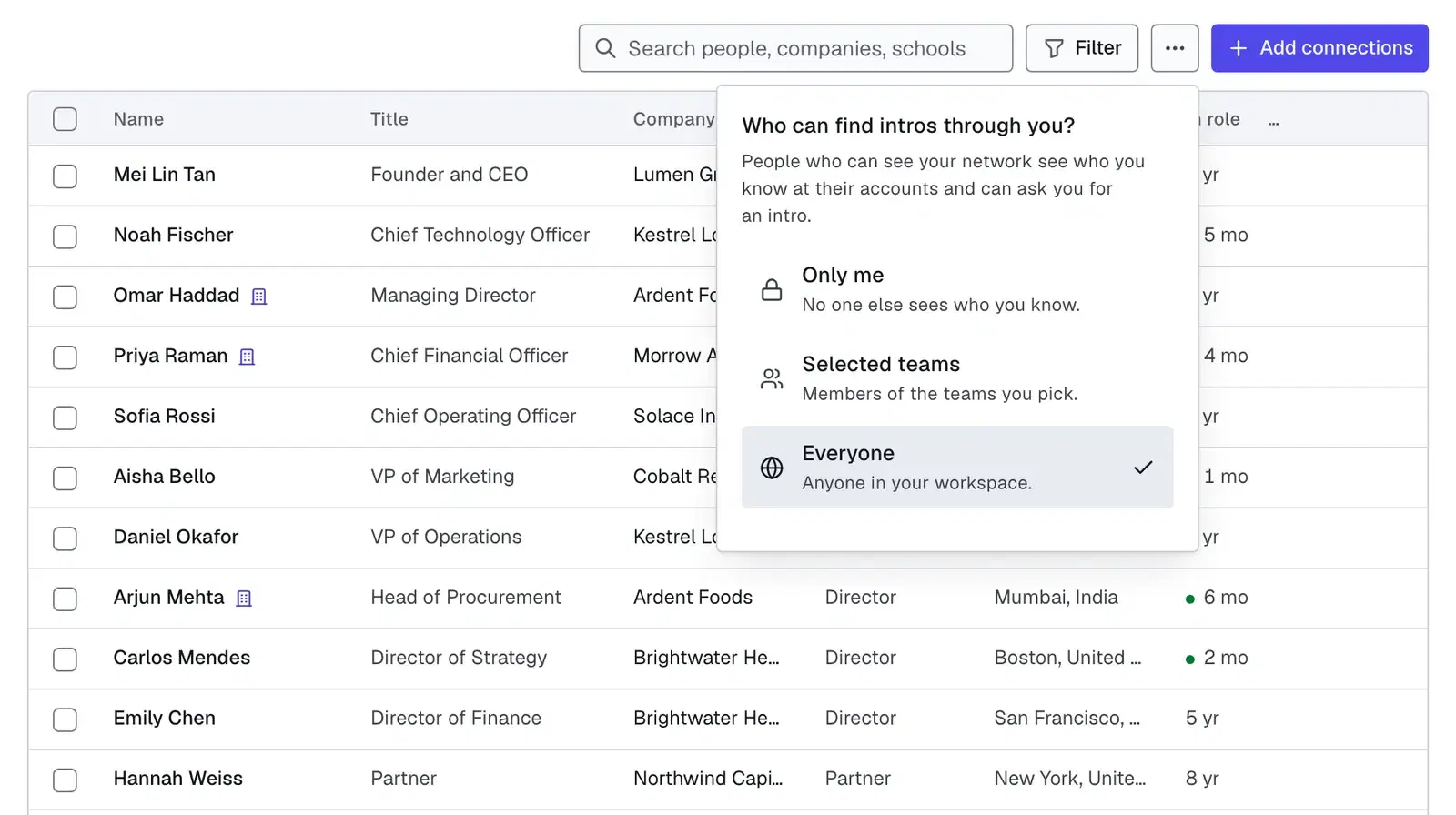
Creating a team used to add only you, so a team named after a colleague could end up without them in it, along with any Key Account shared to it. The create dialog now has a member picker, so you choose who belongs before the team exists.

A team's admin also cannot be dropped from their own team any more. Hand the role to someone else first, or delete the team.

One panel in the Feed

Filters and prep docs shared the Feed with two near-identical collapse controls, and reopening a prep doc you had just closed did nothing. They are now one panel with a Filters and Prep doc tab strip, the same way chat handles its own side panel. A finished packet also links straight through to the Key Account it belongs to, and that link stays put as you scroll.

Also new

  • Prep docs open beside the queue without the sidebar crowding them out, and you can still reopen the sidebar yourself.
  • "Open prep doc" and "View prep doc" are now one label across the queue.
  • Tell Luna something about yourself mid-conversation and she uses it straight away, rather than only in your next chat.
Feature

Forward an email into an account

Send a message to Alkemy and it lands on the right Key Account as a signal, Luna puts your firm knowledge to better use, and you can tell the feed what you do not want to see.

Forward an email into an account

Forward a message to Alkemy and it arrives as a signal on the Key Account it belongs to, with the links and sources it was sent with kept intact. Attachments come along too, so a deck or a report forwarded with the message is read and filed the same way a document you upload would be.

Send a follow-up later and it updates the signal it extends rather than being turned away as something already seen. Industry news and a competitor's move now reach the account they affect, instead of stopping at the company they mention.

Luna puts your firm knowledge to better use

Luna already remembered how your firm works. She now reads that knowledge whenever she writes something a partner would send, so briefs and emails carry your rates, your positioning and your way of describing the work, rather than sounding like a generic consultancy.

Firm knowledge is kept as short, readable entries with a record of who added or changed each one, and written work goes through a drafting pass and a quality check before it reaches you.

Tell the feed what you do not want

Every signal can be marked useful or not. Say a signal missed and Luna asks what was wrong in a quick panel, where you can also ask to see less of that kind of thing for that account. You can mute a signal type outright, and anything you have muted is listed with the rest of the feed filters so you can lift it again later.

Also new

  • Choose your primary organization under Preferences, Account. It decides which workspace your forwarded mail is filed into, and only appears if you belong to more than one.
  • Luna's Queue works like a real queue. Hide, archive or remove items, stop a prep packet that is running, restart one that failed, and open a finished packet beside the feed without leaving it.
  • Long Luna conversations show when a reply is still being written, and flag the ones waiting on you, so a slow answer no longer looks like a stuck one.
  • My Network is faster to import and easier to share, with a clearer connections graph and warm introduction paths.
Feature

Add your own documents to an account

Drop call notes and decks onto a Key Account and get sourced facts back, prep for meetings from Claude or ChatGPT, and choose which privacy options your workspace offers.

Add documents to an account

Every Key Account now has an Add documents button, or you can attach files in a Luna chat. Drop in call notes, decks, contracts or transcripts, up to 25 at a time, and Alkemy files what it learns onto the account with every fact linked back to its document. Filing runs in the background while you carry on working.

Prep for a meeting from Claude or ChatGPT

With Alkemy connected, say "prep me for Acme" and your assistant pulls the brief, the problems worth raising and the prep packet, then writes you a summary. It only sees accounts you can already access, and cannot change anything.

Luna no longer repeats the whole brief back at you. You get a short message and a link to each area she updated, and clicking one opens the account with the chat docked beside it.

Also new

  • Admins choose which privacy options the workspace offers, and where new research lands, under Settings, Workspace, Privacy.
  • One role per person, and the last admin can no longer lock everyone out.
  • Manage your imported LinkedIn connections under Personalization.
  • Billing shows what your role may see, and says whose numbers they are.
  • Luna tells you which credit limit was reached instead of going quiet.
  • Account research costs noticeably less. Some runs were charging more credits than the work behind them used, and pricing has been corrected.
Feature

Team budgets, product help in chat, and briefs in your own format

Set credit budgets for your teams and people, see who spent what, ask Luna how Alkemy works, and design your own brief format without leaving the chat.

Give teams and people a spending limit

Billing now has budget controls. Set a credit budget for each team and for individual members, and Alkemy keeps everyone inside it. Anyone without a budget of their own draws on their team's by default.

When a limit is reached, Luna stops before starting the work and tells you which limit was hit, so nobody finds out after the credits are gone.

See who spent what

Your transaction history now shows who each charge belongs to, and you can filter it by person, which helps when several people share one pool of credits.

Ask Luna how Alkemy works

Use the Product Help command and Luna answers from Alkemy's own documentation instead of searching the web. Ask how Key Accounts work, how to import your data, or what something in the app means, and get an answer grounded in the real product docs.

Design your own brief format in chat

Describe the brief format you want using the Brief Template command, and Luna writes the template and saves it to your Knowledge for reuse. There is a "Generate with Luna" button in Knowledge as well, so you can start from there if you prefer.

The template editor is now for writing a template yourself or uploading one, which keeps the two paths clearly separate.

Feature

Bring your AI assistant, teams, and projects together

Connect Alkemy to Claude or ChatGPT, choose your team from the sidebar, and switch projects directly in GridIQ.

Connect Alkemy to supported AI assistants such as Claude and ChatGPT. Sign in, choose your workspace, and ask about Key Accounts without leaving the conversation. Your assistant can only explore the accounts you already have access to, and it cannot make changes.

Teams now appear in the sidebar where Projects used to be. Choose the team you are working with, and new Key Accounts go there by default. When you need to switch projects, open GridIQ and choose one on that page — even if the table is empty.

Feature

A smoother mobile experience, live support, warmer intros, briefs your way, private accounts, and fresher signals

Warm introduction paths across your whole firm, account briefs in a format you design, visibility controls on every Key Account, signals clearly marked as new, plus a smoother mobile experience and live support.

A better experience on smaller screens

Navigation, account views, the feed, chat, settings, and billing now adapt more cleanly to mobile screens, making important controls easier to reach and content easier to read wherever you work.

Dense pages have also been reorganized for smaller screens, so you can review account details, move between sections, and take common actions without fighting a desktop layout on your phone.

Live support when you need it

Workspace admins can now open live support access from the Help menu, choose what the Alkemy team can view, and decide how long access should remain open. Access is read-only and can be revoked at any time.

You can include a short description of the problem and limit access to only the relevant parts of your workspace. This gives the support team the context they need while keeping everything else private and unchanged.

Find warmer ways to reach the people you want

When you're trying to reach someone at an account, a direct connection isn't always there. Warm introduction paths now look across your whole firm, not just the people you know directly — Luna finds the shortest chain of colleagues who can pass you along and shows the best route in, read top to bottom: you, the person who can introduce you, and the contact you're after.

So even when you've never met anyone at a target company, you can see the warmest way in and exactly who to ask for the introduction.

Design how Luna writes your account briefs

You can now decide exactly how your account briefs are laid out. In Knowledge → Templates, describe the format you want in plain language — say, the three people who matter most, what could put a deal at risk, and the one move to make next — and Luna writes the format for you. Refine it just by asking ("make it shorter", "add a competitors table"), or start from a ready-made format like Cliff Notes or a Blue Sheet.

Set a format as your preferred one and every brief Luna writes for you follows it — the same sections, in your style, filled in with the latest on the account. Keep a format to yourself, share it with a team, or set one for the whole workspace.

Decide who sees each Key Account

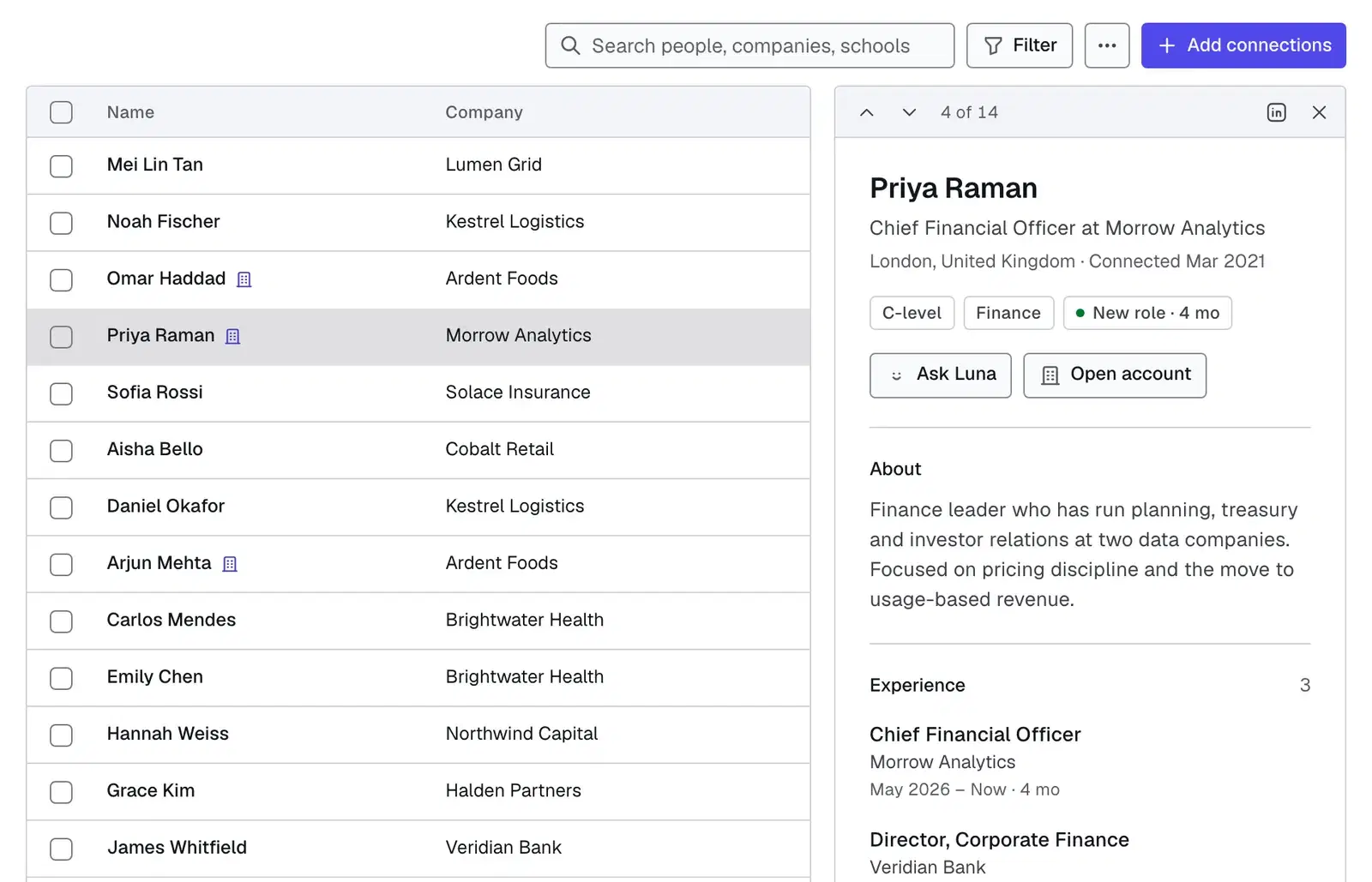
Every Key Account now has its own visibility setting, controlled from the lock in the account header. Keep it private to you alone, share it with one or more teams, or leave it open to everyone in your workspace.

Whether someone can edit an account or only view it follows their role on the team that owns it, set in Settings, Teams, Manage Members. Whoever created an account always keeps full control of it. Luna follows the same rules: she will not show or describe an account you cannot access, and you can simply ask her to share one with a team.

Existing accounts stay visible to everyone in your workspace, so nothing disappears. Editing is now tied to team roles, so some people may find they can view an account they used to be able to change until they are added to the right team.

Fresher signals, clearly marked as new

Refreshing an account now surfaces genuinely recent, properly dated news, so developments that used to slip past are picked up. Start a refresh and close the tab if you like, the result is waiting when you come back.

Every signal carries a New tag until you personally open it, and Updated if it changed since you last read it. That is tracked for each person, so the Signals tab badge shows your own unread count. When fresh information lands on something already being tracked, it updates that signal instead of adding a second copy of it.

Luna remembers what you tell her

Tell Luna something about an account, a person, or how your firm works, and she saves it on her own and tells you afterwards. No stopping to confirm every note, and no being asked twice about something you already said during onboarding. Those notes come back the next time you work on that account, and when a detail changes the old note is corrected instead of piling up beside the new one.

She is also better at finding them. Where Luna would occasionally say you had no Key Accounts, or miss a detail already saved in one, she now searches across every account you have access to.
Feature

Monthly plans, and signals that refresh on your schedule

New monthly Starter and Growth plans, plus opt-in schedules that keep your Key Account signals fresh automatically — in your timezone.

Two big changes land today: a simpler way to pay month to month, and a way to keep your account signals fresh without lifting a finger.

Monthly plans that fit how you work

Instead of buying credits in one-off packs, you can now subscribe monthly. Starter gives you 10,000 credits a month and Growth gives you 60,000 — and every new workspace starts with 2,000 free credits to try things out. Manage it all from your billing page: upgrade instantly and only pay the difference, cancel anytime, or pick back up where you left off. Credits refresh automatically each month and roll over for up to a year before they expire, oldest first.

Signals that refresh on your schedule

You can now set a Key Account to refresh its signals automatically — hourly, daily, on weekdays, or weekly — at a time and timezone you choose. Set it once and new signals like executive hires, funding, and deals keep showing up on their own, with no need to hit Track Now. A new Settings page lets you see and manage every schedule in one place, and even accounts you never schedule get a periodic refresh so nothing goes stale.

Feature

A smarter start, faster search, and one feed for every signal

A redesigned onboarding that researches your company for you, search that reaches across your whole workspace, and a single feed for every account signal.

Three big updates land today: a smoother way to get started, search that reaches everywhere, and one place to catch every signal across your accounts.

A smarter start

Setting up your workspace is now a single, guided screen instead of a stack of forms. Tell us your company, and we'll research it for you in the background — pulling together a first look at who you are while you finish setting up, so your workspace already has something useful in it the moment you land.

Search that reaches everywhere

Search now looks across your whole workspace, not just one list at a time. Open it and search for an account, a company, or a past conversation, and jump straight there — no more hunting through the right page first.

One feed for everything happening

Instead of checking each account's signals one by one, there's now a single feed that brings them all together, newest first. Like or dislike a signal to help shape what surfaces for you, and use "Want to meet" right from the feed to kick off a meeting-prep brief — no need to open the account first. A running list of your in-progress and completed briefs sits alongside the feed so you always know where things stand.

Feature

A new home for docs and updates

A searchable docs site with getting-started guides, and this changelog to track what's new.

We built a proper docs site — searchable, organized by what you're trying to do, with guides for getting started, using Luna, and working with Key Accounts and GridIQ.

And you're looking at the other half: this changelog. We'll post here whenever something new ships, so you don't have to guess what changed.

Improvement

A more reliable Key Accounts

Faster, more reliable LinkedIn lookups, a tidier Prep Packet, and a guided first run.

LinkedIn lookups are now faster and more reliable, including for firm roster CSV imports with a LinkedIn URL column. Importing a roster no longer fails when a company link is missing, either — Luna looks it up or asks you instead of erroring out. We also tightened matching so people from the wrong company no longer show up on an account.

Prep Packets got tidier too: supporting details now live in a collapsible appendix instead of crowding the main brief, with tooltips explaining anything unfamiliar.

First time opening Key Accounts? You'll now see a guided starting point instead of a blank page.

Feature

Faster, live account research

Full account briefs come back faster, with live progress you can watch as Luna researches.

Building a full account brief used to be one long research pass. Now Luna splits the work across several research threads running at once, so a complete brief comes back noticeably faster.

You can also watch it happen live — each thread shows what it's finding and doing as it works, right in the chat, instead of a single spinner.

Feature

New pricing, clearer purchases

Three simple plans, a credit FAQ, usage breakdowns, and promo codes at checkout.

Pricing is easier to compare now: Starter, Growth, and Enterprise, each with clear guidance on how much usage to expect and transparent per-credit rates.

Improvement

A round of UI polish

Cleaner onboarding, pricing, and Luna project pages, plus a batch of general fixes.

Starting a new project, Luna can now help you set it up instead of leaving you with a blank form, and GridIQ opens with a clear goal-first prompt instead of an empty table. We also renamed "Run Track now" to the clearer Refresh Signals.

Signing up got a little smoother — your name and workspace are now pre-filled from your email instead of asking twice, and we fixed a bug where signing in could occasionally land you in the wrong organization. Pricing pages got a visual cleanup, and a handful of smaller interface fixes landed across the app.